"You Burn Me" - Stung by Media!
Uni has a way of throwing you these little curveballs that make your chest ache in the best and worst ways. This week mine came in the form of a recommendation for Portrait of a Lady on Fire (2018) as part of reception studies in classical literature. Honestly for the first chunk, you would be forgiven for saying that "nothing happens" and that's almost true.... Forty-five minutes in, it's a language of stolen glances, barely a word exchanged at times, and yet it grips you completely. It feels like someone has taken the awkward, burning intensity of a Sapphic crush and put it on screen. It is savage. The baited breaths, the eye contact, the conversations behind the eyes, and the YEARNING..... BRUTAL! My heart went in my mouth several times, and it was agony! Seriously.
Céline Sciamma is a genius at making you feel like a voyeur. The sound design is understated and gorgeous, the kind of subtlety that makes you hold your breath. The camera follows Marianne and Héloïse in a way that makes you feel like a third wheel. You are there in the shadows, caught between wanting to look away and not being able to. Sciamma understands the female gaze for the female gays, and it is devastating.
Every look, every small movement, every quiet breath matters. You feel like you are living inside the tension, inside the waiting. A week after seeing this movie and I am VERY MUCH. NOT OK. The quiet is deafening. When Marianne and Héloïse are in the same room, the air between them is charged. Every glance, every subtle shift in expression, every brush of a hand against fabric feels like it could combust. Sciamma doesn’t give you big gestures or declarations. She gives you the tension, and the tension is unbearable. It’s intimate, devastating, and utterly riveting. You feel like a voyeur in the best and worst way. You are aware of your own breath, of the silence, of every inch of space between them. It makes you ache. It makes you feel something you thought you could only read about. I am still feeling like I have been split open and my guts are out on display, because WHY IS THIS SO ACCURATE?

The sound design is subtle and gorgeous. The silence is punctuated by just enough music or environmental noise to make you lean in, to make every rustle of fabric, every clink of a cup, every sigh, mean something. You are not watching a romance unfold; you are living it in the small moments that no one else notices.
Basically in this film a Portrait artist "Marianne" is contracted to produce a portrait of a bride-to-be fresh out of a convent "Heloise" for an arranged marriage against her will... juicy, and the subject of agency pops up a metric shed-tonne in "Stung by Love" the Penguin classics edition of Sappho's poems and fragments that I have...
It's geeky, but the connection is there, and from what has been said, we know that agency, and the topic of agency and love was important to Sappho.
"Like Euripedes' Medea, Sappho uses military images and diction to elevate the events of female life to a level equal with those of a male's. Furthermore rather than presenting female characters as objects of desire, Sappho presents us with female characters who act autonomously"
- Carol Ann Duffy, stung with love pp.31-32
There is also an undercurrent of Orpheus in the underworld running through the film. The myth mirrors Héloïse and Marianne’s experience in such a painful way. Héloïse reads aloud from the book, the story of Orpheus and Eurydice echoing their own constrained desire. Orpheus must choose, and when he turns, when he finally looks, it is too late. Eurydice has been there all along, begging him to see her, and the Fates are cruel. That sense of suspended, unbearable longing is mirrored in the glances and silences of Portrait of a Lady on Fire.
Page 28, being forever referenced to like:
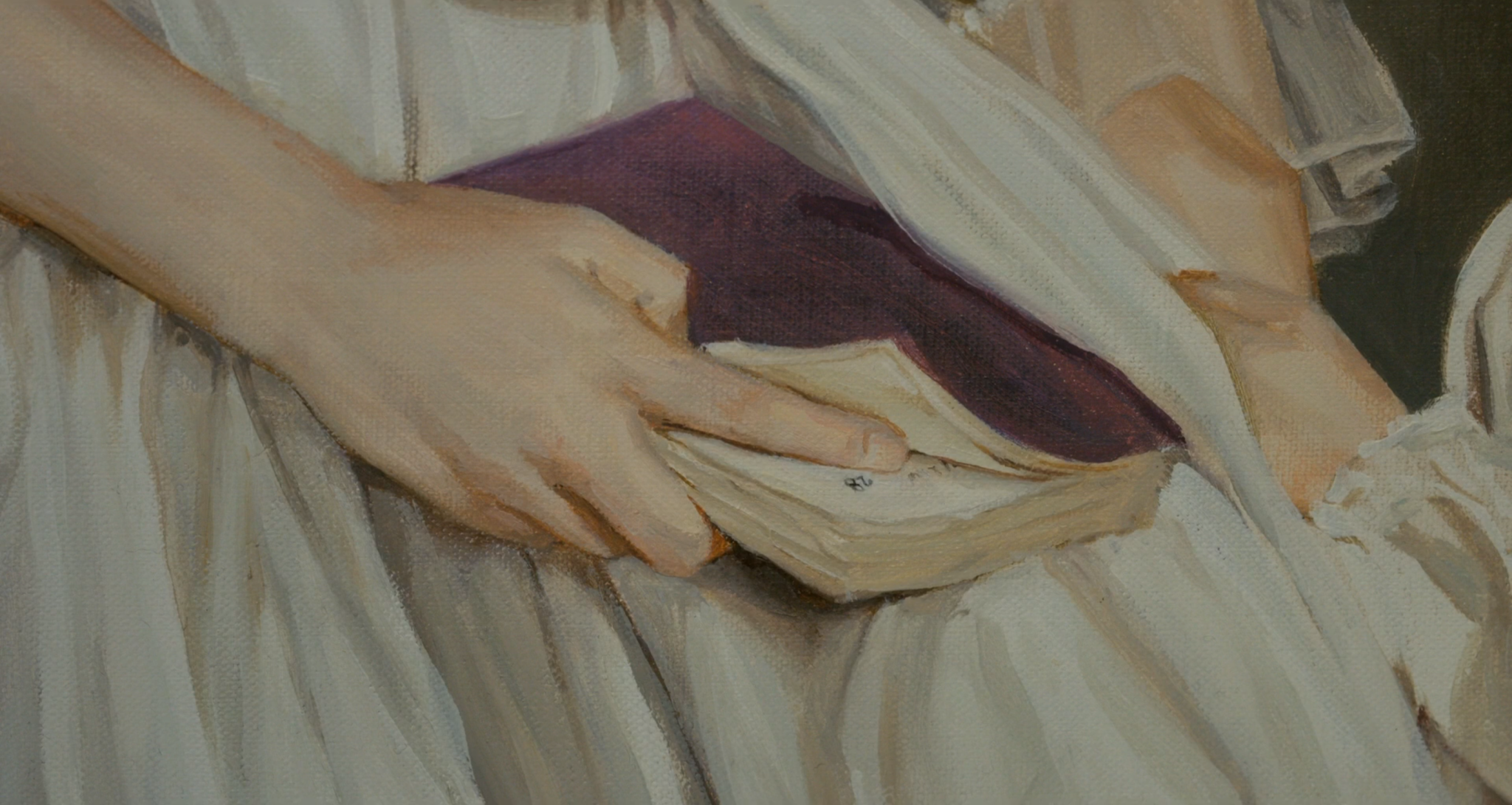
I won't lie the moment I saw this, I immediately jumped to Jen Mazza's "Red Letter" portraits, because:
I'd been to watch Hadestown in the West End in London for my brother's birthday during Christmas last year and so the Orpheus storyline was more than fresh in my head but quietly devastating, as it speaks to Hades as a place one goes to, inside the head...a negative headspace.. for instance Persephone with her raging substance abuse "Takes a lot of medicine... to get me through the Winter-time!" and "Maybe you're looking for some stronger stuff?" and the ever-present "Anybody wanna drink?" . With this in mind, it is possible for one to be dead on the inside long before they depart the land of the living...

Hermes warns him that doubt is the dog that he really has to fear more than any other creature that could tear him limb from limb on his travels.
"The meanest dog you'll ever meet, he aint the hound-dog in the street...
He bares some teeth and tears some skin, but brother that's the worst of him.
The dog you really gotta dread is the one that howls inside your head,
it's him whose howling drives men mad, and mind to its undoing..."
- Hermes, Hadestown

The way doubt creeps in, the way desire battles fear and fate, it is echoed in Marianne’s paintings and her stolen glances at Héloïse. Hermes’ cautionary advice from earlier in the show about the meanest dog, the one who howls inside your head and drives men to madness, resonates here. Desire and fear gnaw from the inside.
In Portrait of a Lady on Fire, when Marianne finally immortalises Héloïse in the painting of her wedding dress, it is a quiet act of rebellion. A man comments on its beauty, assuming it is a farewell, but Marianne’s authorship, her subversion of the comp-het world, goes completely ignored. That frustration, that erasure, feels like a mirror of Sappho’s experience. While reading her fragments, one line haunted me: “You burn me” (Fragment 38). That line is embodied when Marianne destroys the headless portrait she finds in the house, drags it to the hearth, and watches it burn. The fire mirrors the intensity of a love that is brief, contained, and forbidden. It is destructive, it is urgent, it is unforgettable.
Their love can never transcend that house, never leave the contained space, and the way Marianne just watches the cinders burn in the fire is deeply poetic, and also intriguing, because for a moment, I was watching thinking that she would take the faceless portrait, and simply finish it... But she doesn't.....
Sciamma’s use of colour is also incredible. The deep emerald green of Héloïse’s surroundings stands for stability, health, wealth, and growth, yet it clashes with her own palette and her grey eyes, signaling the practical prison of her arranged marriage. Even in beauty, there is constraint. Even in desire, there is tension. The visual storytelling is so deliberate, so precise, that you feel it as a physical ache. Every glance and gesture is a spark. Every look that lingers too long makes your heart catch in your throat.
Even when Marianne finally sees Héloïse in the concert hall for the last time, Vivaldi’s Summer plays and the moment hits differently. The spring of their love is over, leaving only memory, longing, and the knowledge that life moves forward. It feels unfinished, abrupt, impossible. Yet it is beautiful. It burns. It stays with you.
The threads from the cursed Orpheus, from Sappho’s fragments, from Hozier’s Talk all connect. In the song, he uses second person to turn the listener into the beloved and boasts, “I’d be the choiceless hoping grief that drives him underground, I’d be the dreadful need in the devotee that made him turn around, and I’d be the immediate forgiveness in Eurydice.” Crushing, intoxicating, impossible. It is the ache of being seen, the ache of loving someone who may not fully see you back, and the ache of knowing that memory and longing are all that remain in the end.
- Hozier, Talk
Orpheus, Héloïse, Marianne, Sappho, Hozier, they all remind me that longing, grief, courage, and creation are worth holding onto, even when constrained or fleeting. The silence, the fire, the gazes, the doubt, the black dog, the green of life imposed, the inevitability of transition, the impossibility of being entirely reciprocated, they all burn and ache, but they also illuminate something incandescent in you. They leave memory. They leave proof that your heart is capable of extraordinary intensity.
Even if the story is unfinished, even if the fire is brief, even if the silence and doubt feel unbearable, there is hope. There is beauty. There is fire. One day, that fire will ignite something new, even if only in memory, even if only in longing. Hold onto it. Let it remind you that to feel this deeply is a gift, even when it hurts, even when it burns.


Comments
Post a Comment